shipslides
Examples/Philosophy
Vol. V / 25 decks

Philosophy

Ethics, logic, mind, meaning, politics, aesthetics, pragmatism, and ancient traditions. Browse curated, sandboxed HTML presentation decks in Philosophy, each with crawlable summaries, slide outlines, and topic metadata.

25
Decks
429
Slides
Philosophy14 slides

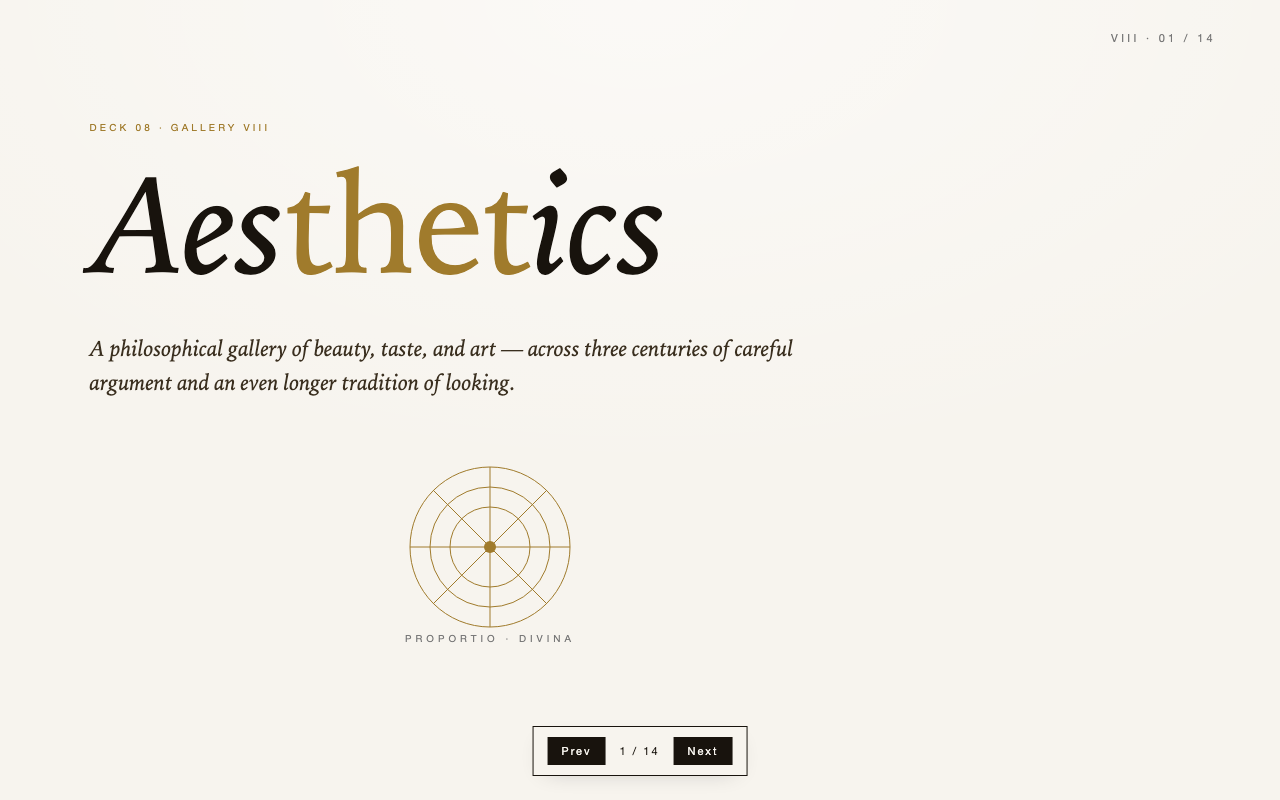
Aesthetics — Deck 08

A philosophical gallery of beauty, taste, and art — across three centuries of careful argument and an even longer tradition of looking.

Philosophy15 slides

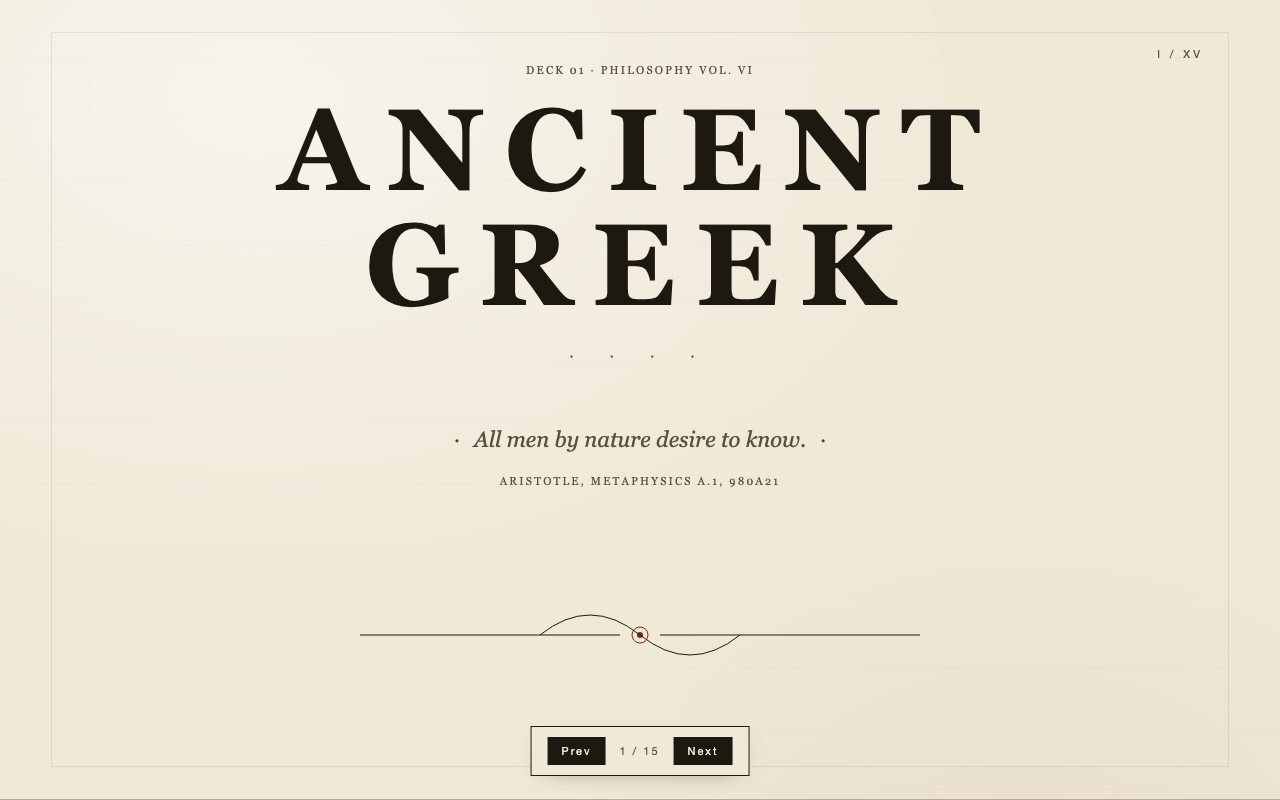
Ancient Greek Philosophy — Deck 01

All men by nature desire to know.

Philosophy14 slides

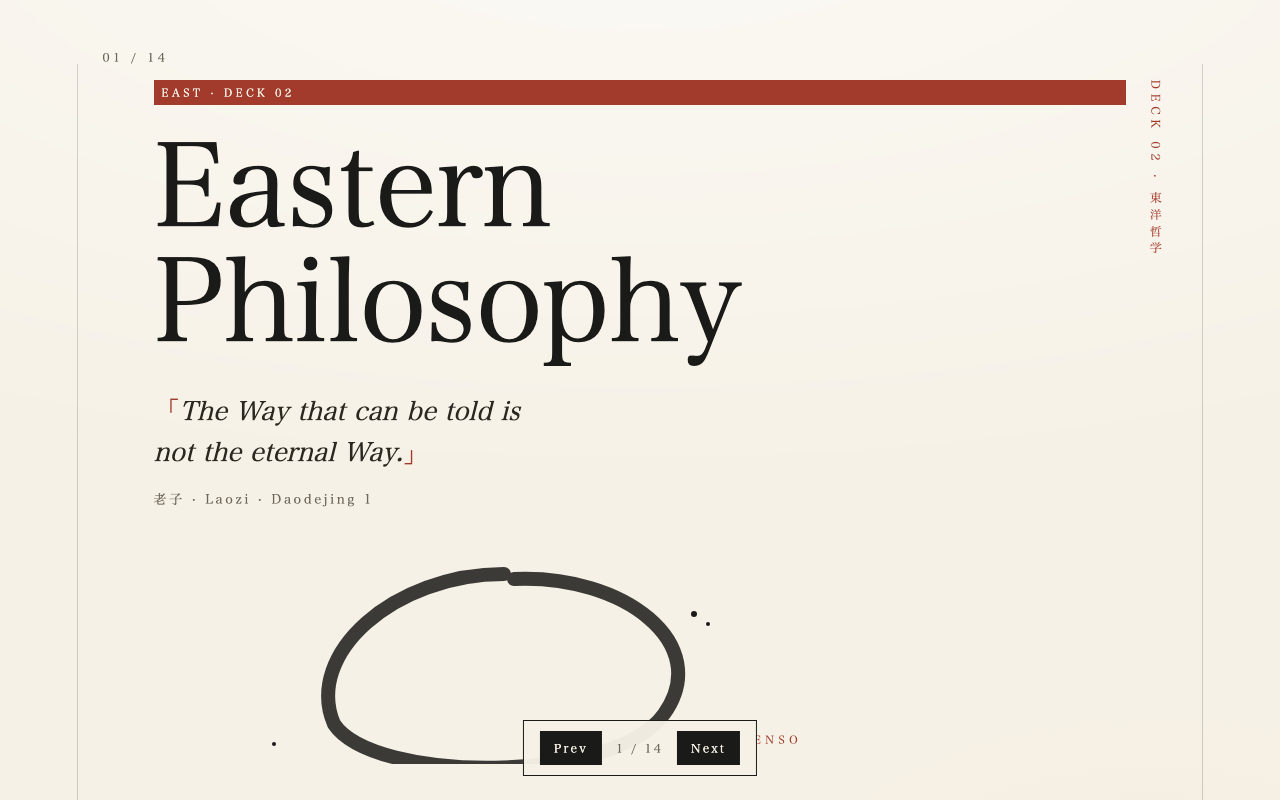
Eastern Philosophy — Deck 02

The Way that can be told is not the eternal Way.

Philosophy30 slides

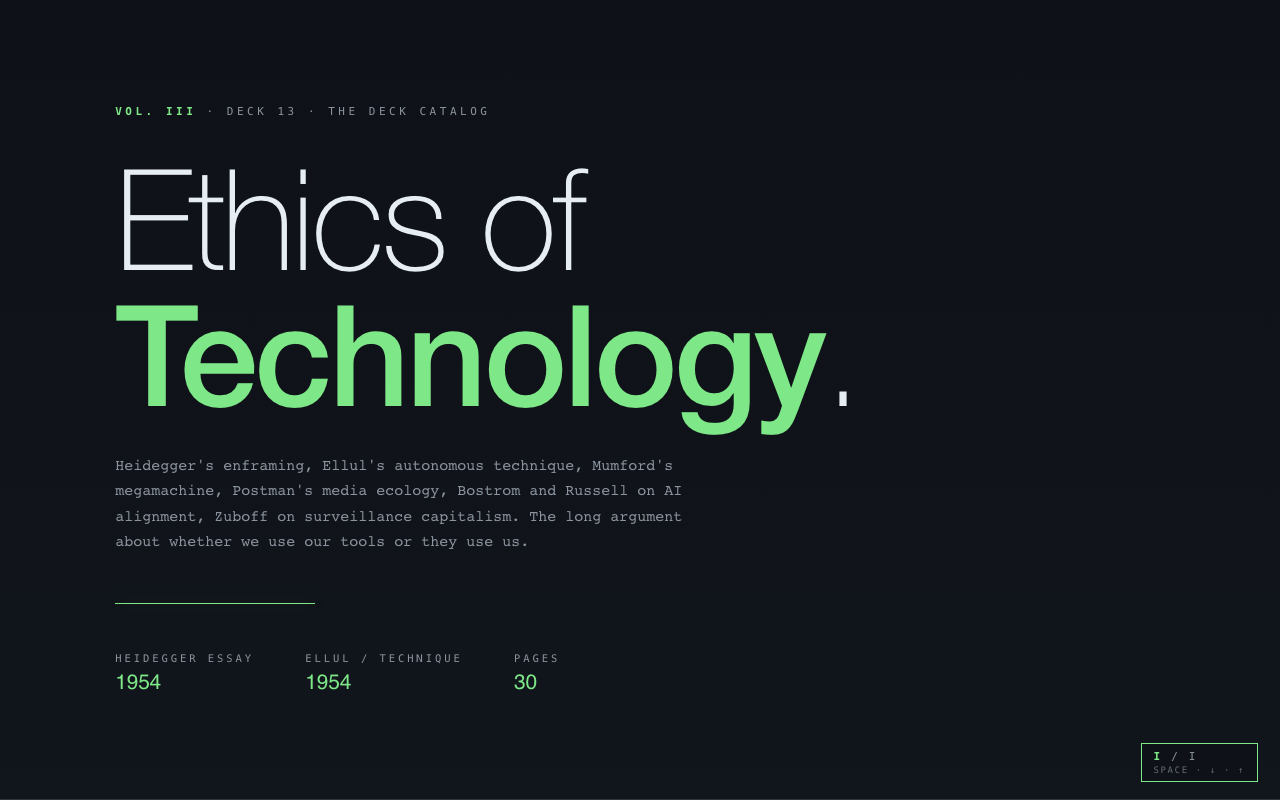
Ethics of Technology

The philosophy of technology is the philosophical investigation of artefacts, systems, and the practices they sustain. It is younger than most of philosophy and older than most of computing — its modern form took shape in the mid-20th century, when Heidegger, Ellul, and Mumford each independently concluded that the technological systems of industrial modernity had begun to reshape the humans inside them.

Philosophy14 slides

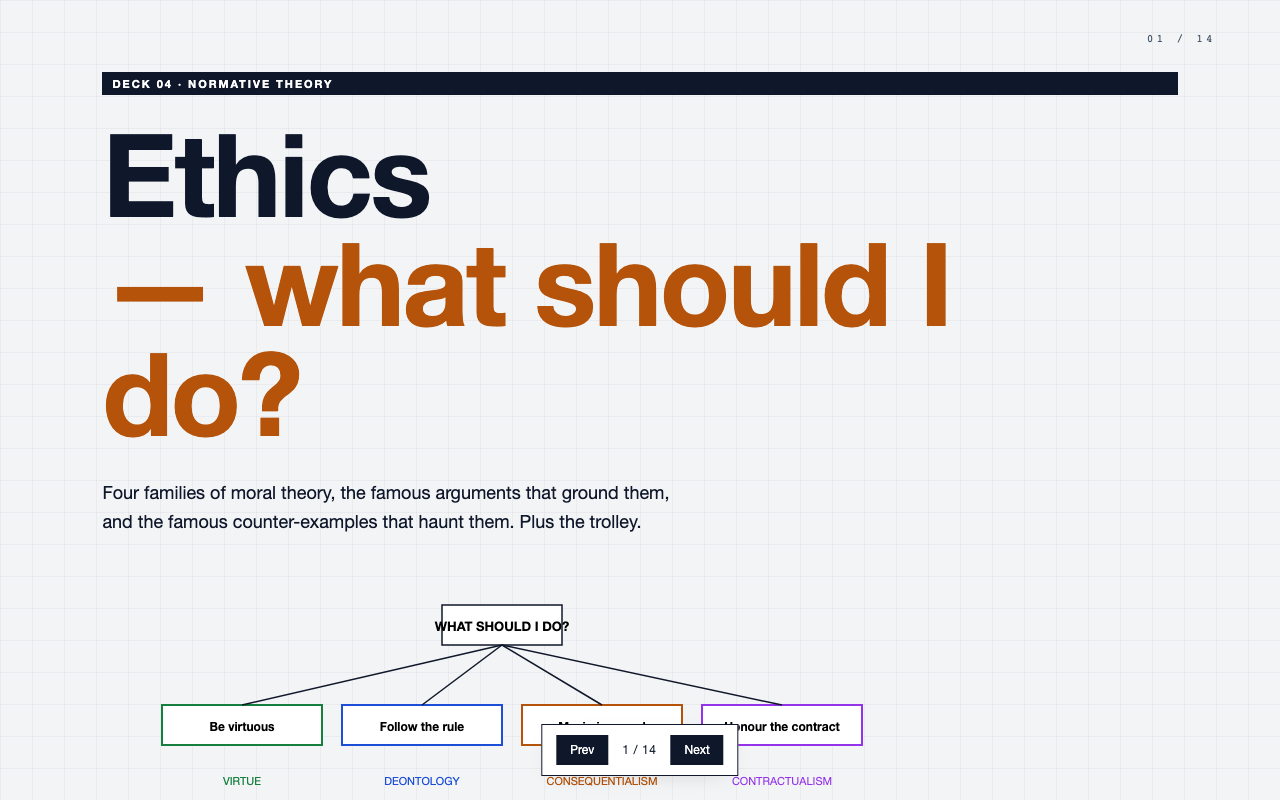
Ethics — Deck 04

Four families of moral theory, the famous arguments that ground them, and the famous counter-examples that haunt them. Plus the trolley.

Philosophy16 slides

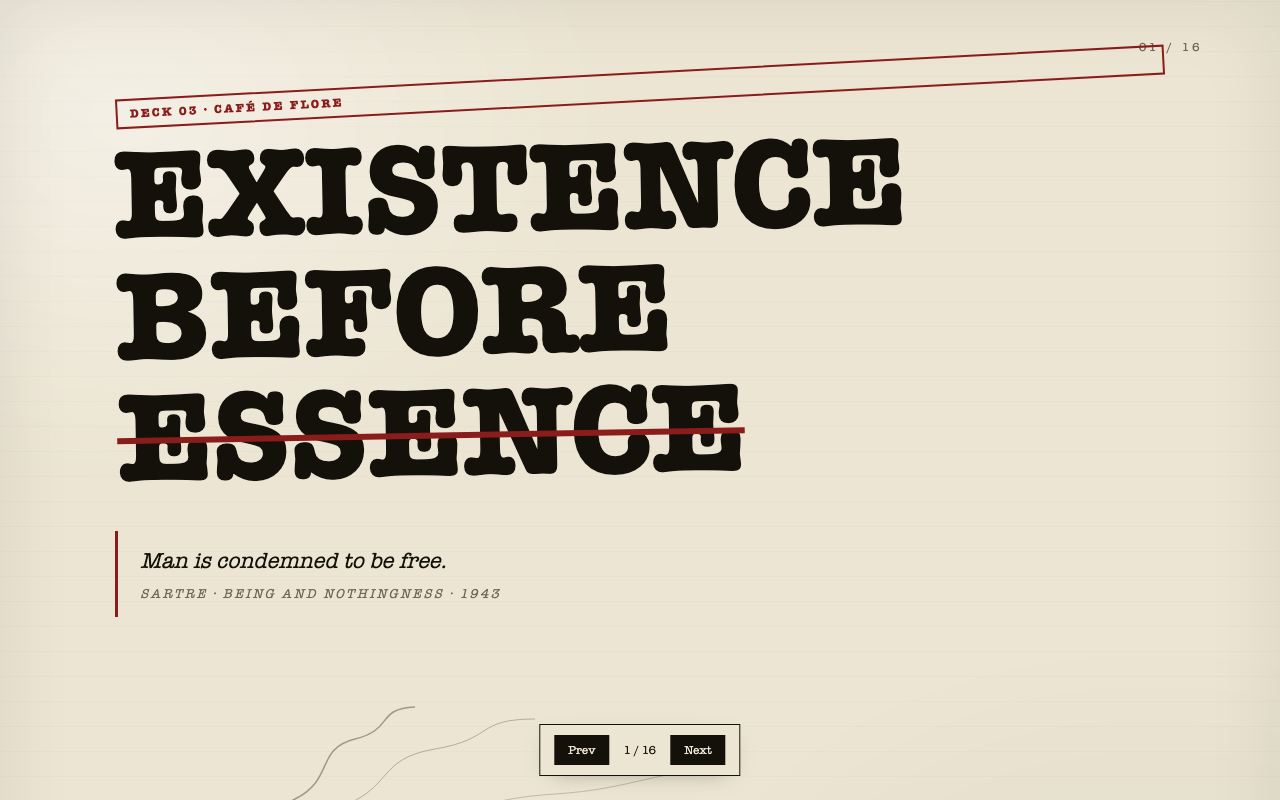
Existentialism — Deck 03

Existentialism is not a doctrine. It is a family of related insistences. Existence (the lived, particular, situated) precedes essence (the abstract, general, defined). The human being is not a thing with a fixed nature; it is a project that has to be made up as it goes. Freedom comes with anguish. Authenticity is rare and difficult. Death is not the end of life so much as life's organising fact.

Philosophy15 slides

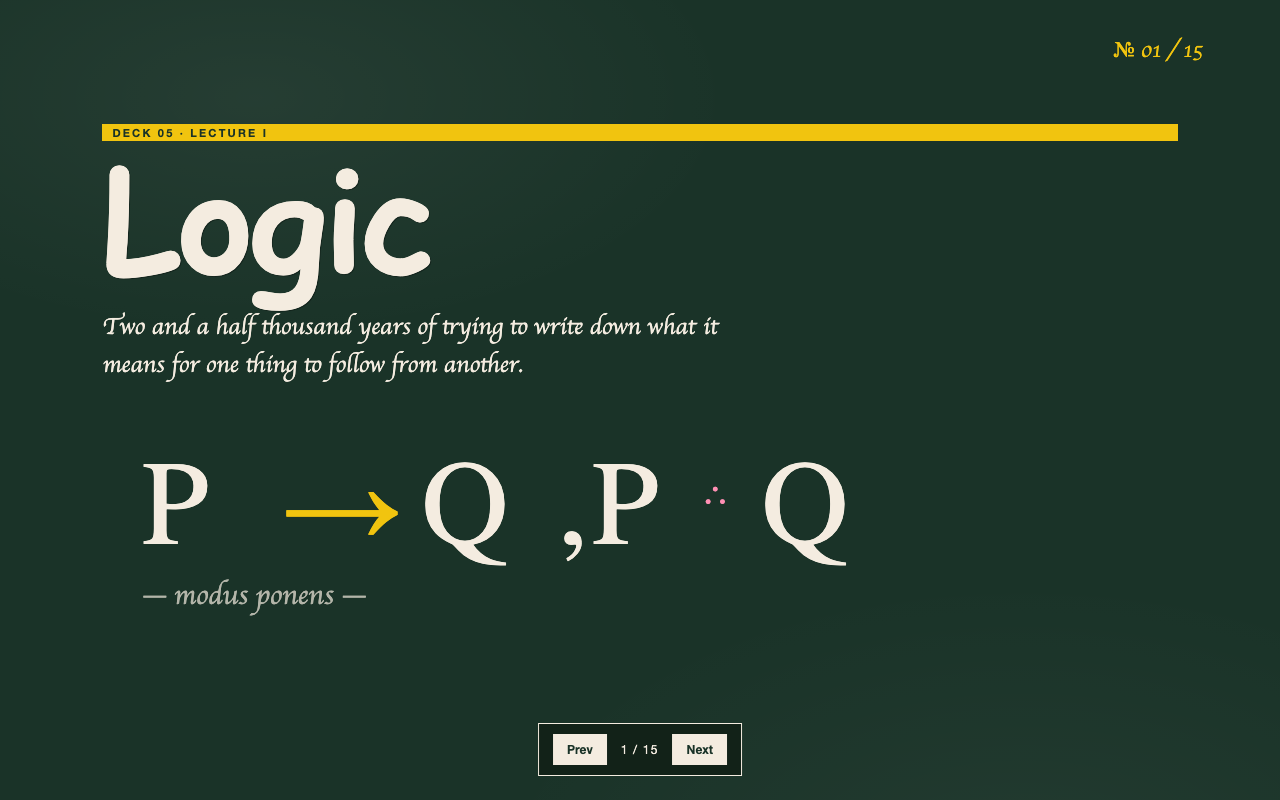
Logic — Deck 05

Two and a half thousand years of trying to write down what it means for one thing to follow from another.

Philosophy30 slides

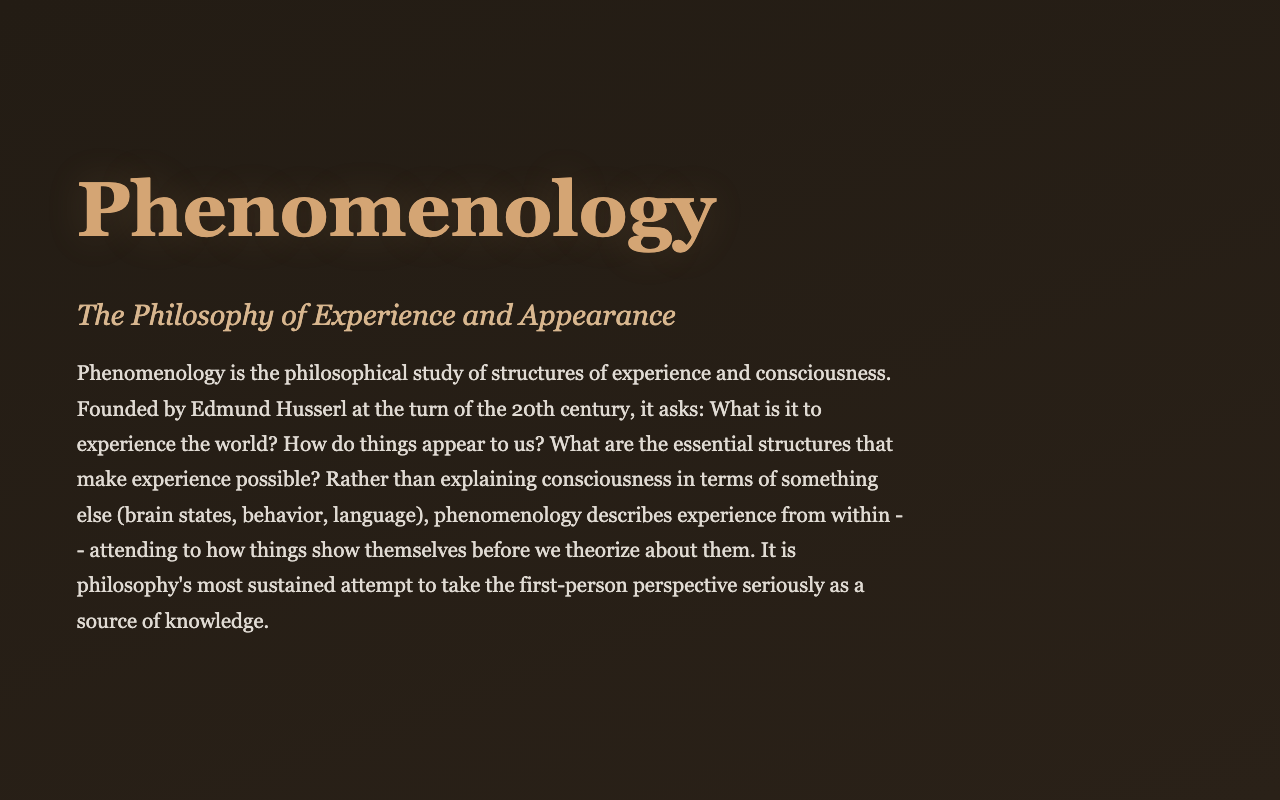
Phenomenology

The Philosophy of Experience and Appearance

Philosophy30 slides

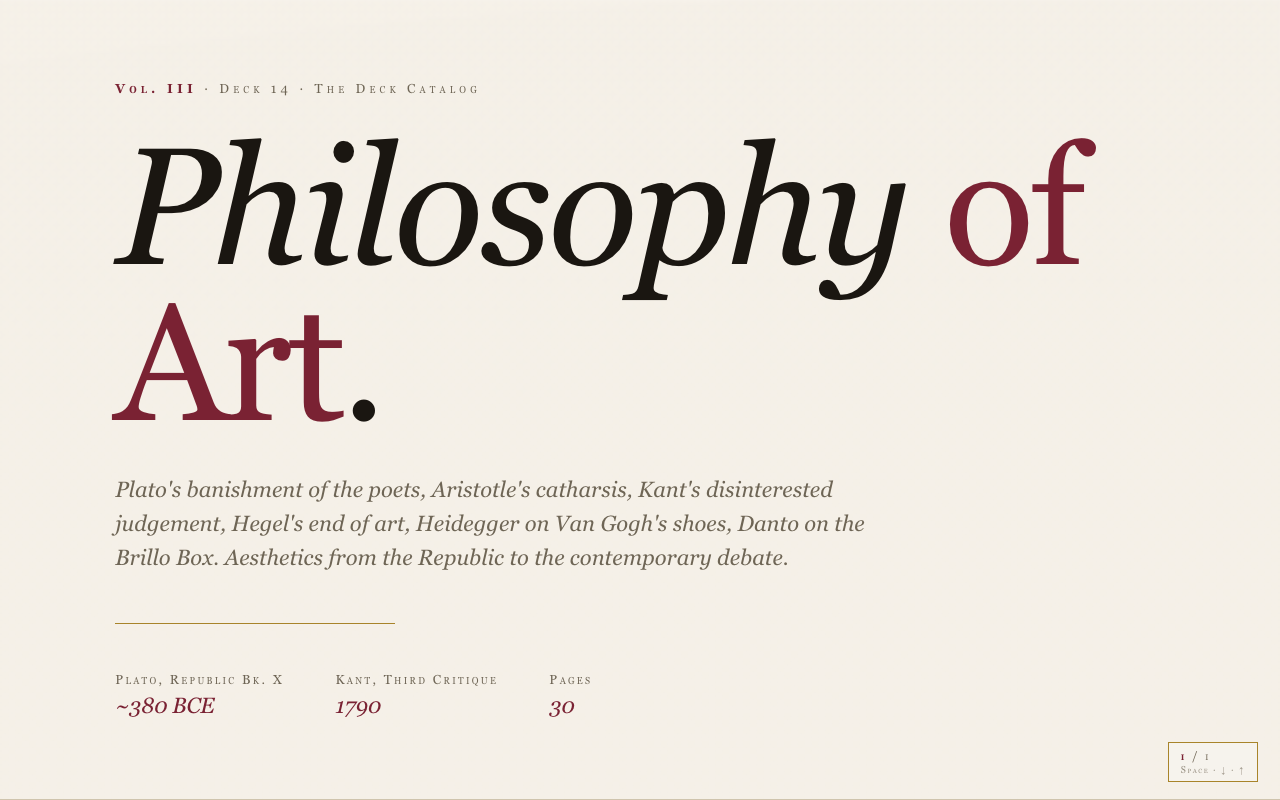
Philosophy of Art

The philosophy of art is the philosophical investigation of what art is, what makes something beautiful, what aesthetic experience consists in, and why any of it matters. The discipline is as old as Plato's Republic and as current as last week's debate about whether AI-generated images are art.

Philosophy30 slides

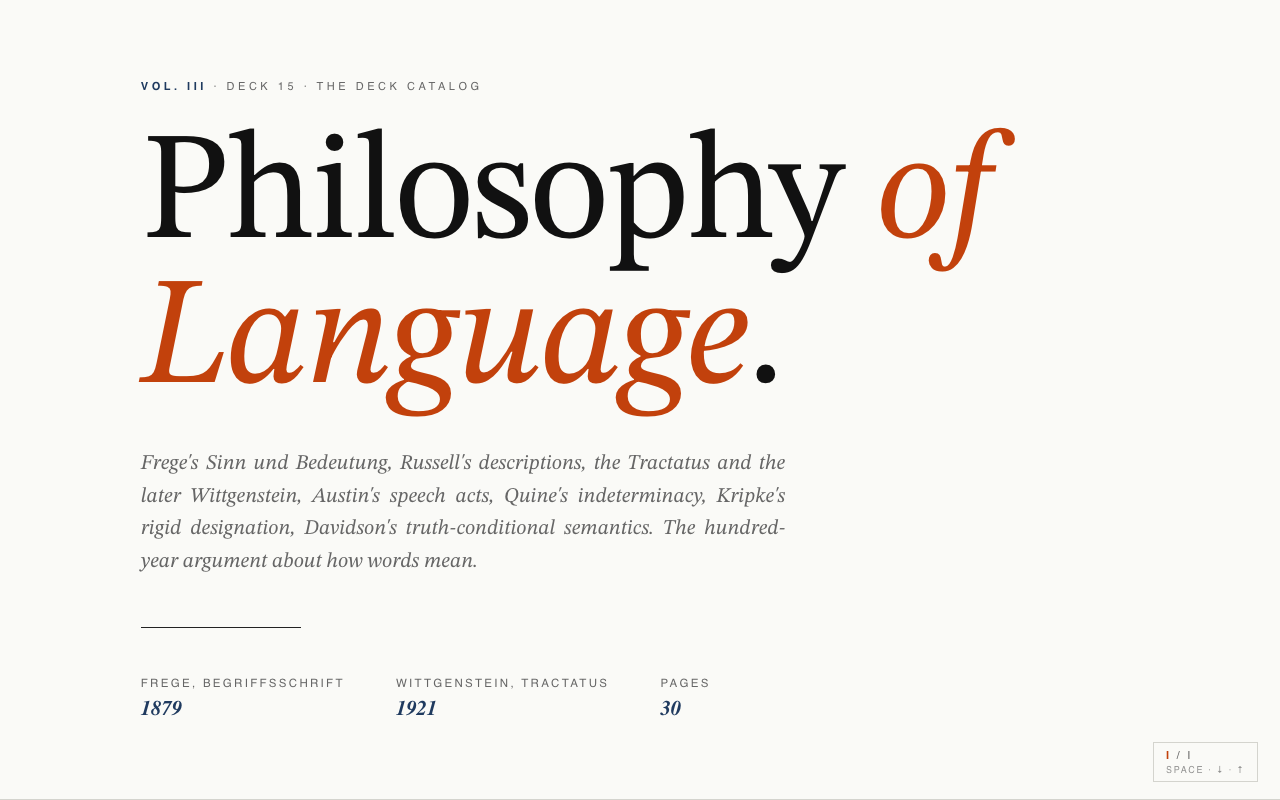
Philosophy of Language

The philosophy of language is the philosophical investigation of meaning, reference, truth, and the relation of language to thought and world. As an organised research programme, it is the central achievement of analytic philosophy — the discipline that, in the early 20th century, redirected philosophical attention from the structure of consciousness to the structure of language.

Philosophy15 slides

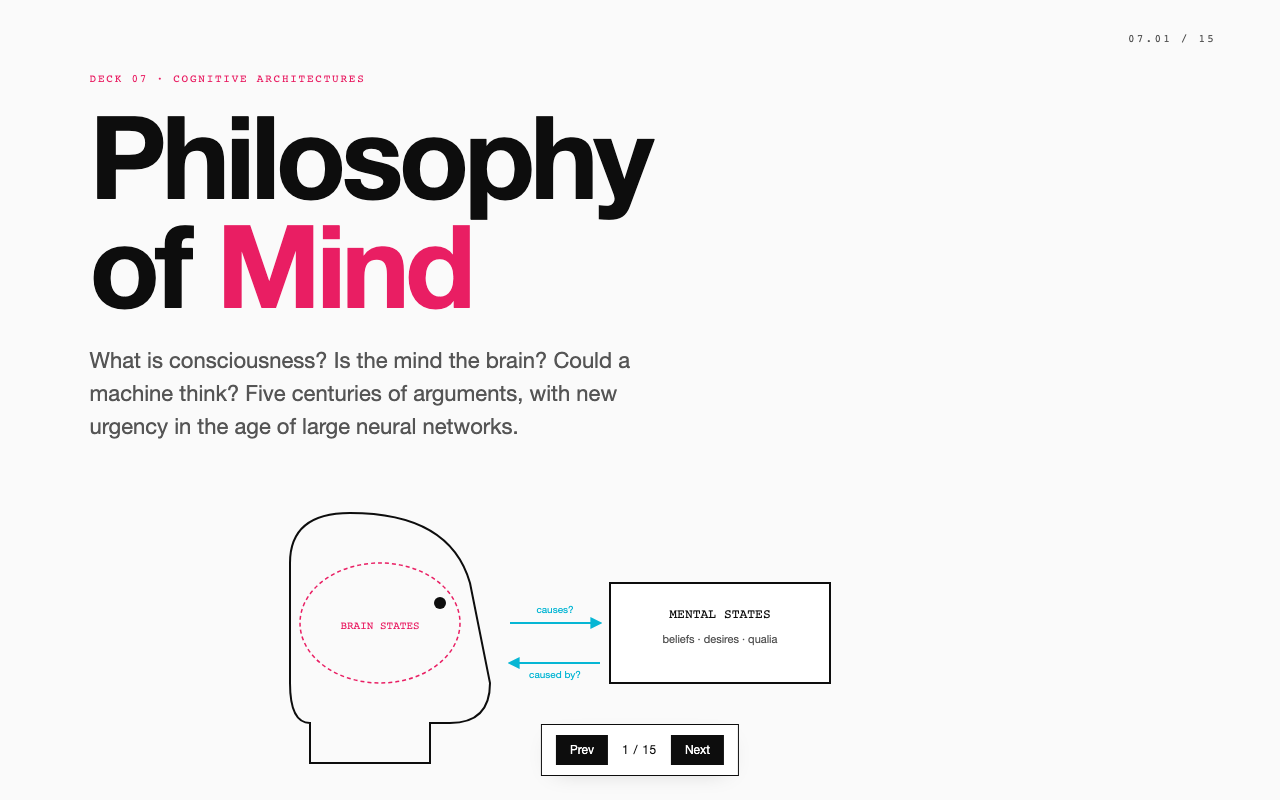
Philosophy of Mind — Deck 07

What is consciousness? Is the mind the brain? Could a machine think? Five centuries of arguments, with new urgency in the age of large neural networks.

Philosophy32 slides

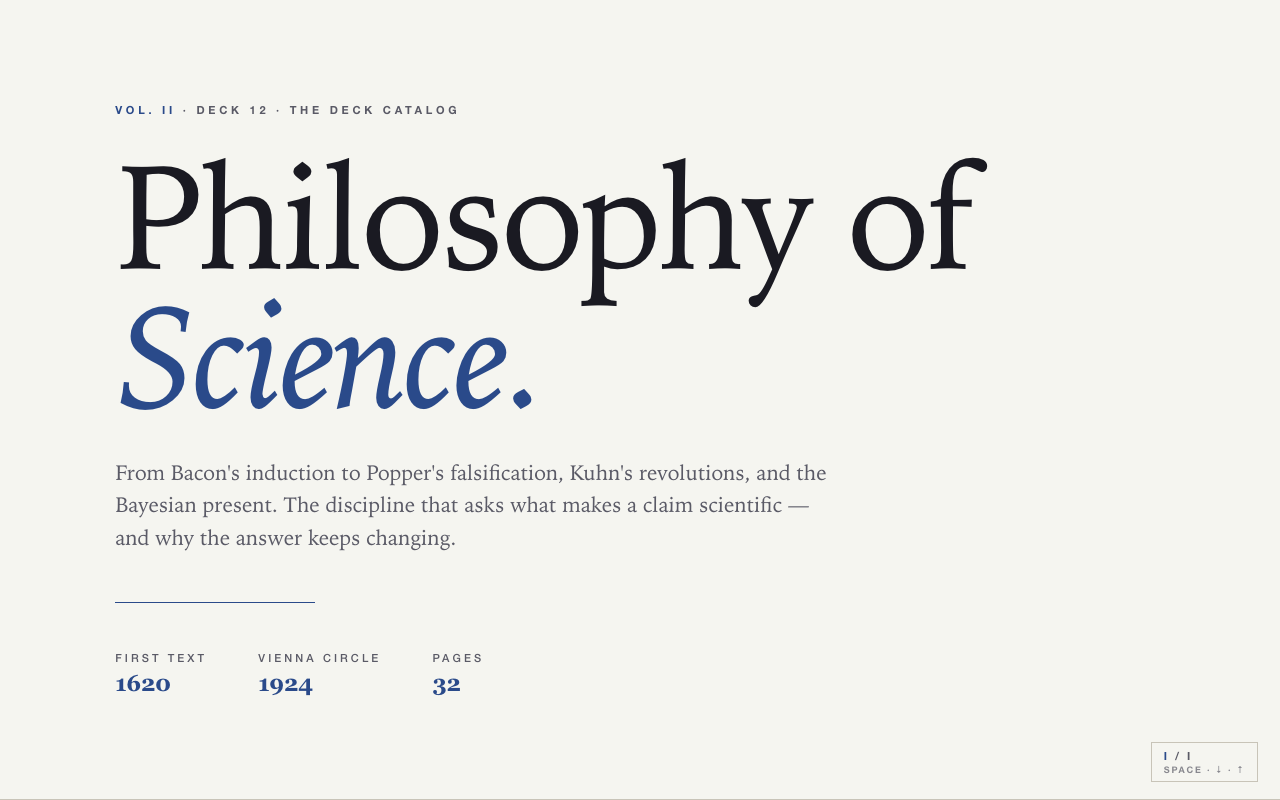
Philosophy of Science

A second-order discipline. Philosophy of science does not do science; it studies what scientists do, what they should do, and why we are entitled to believe them.

Philosophy14 slides

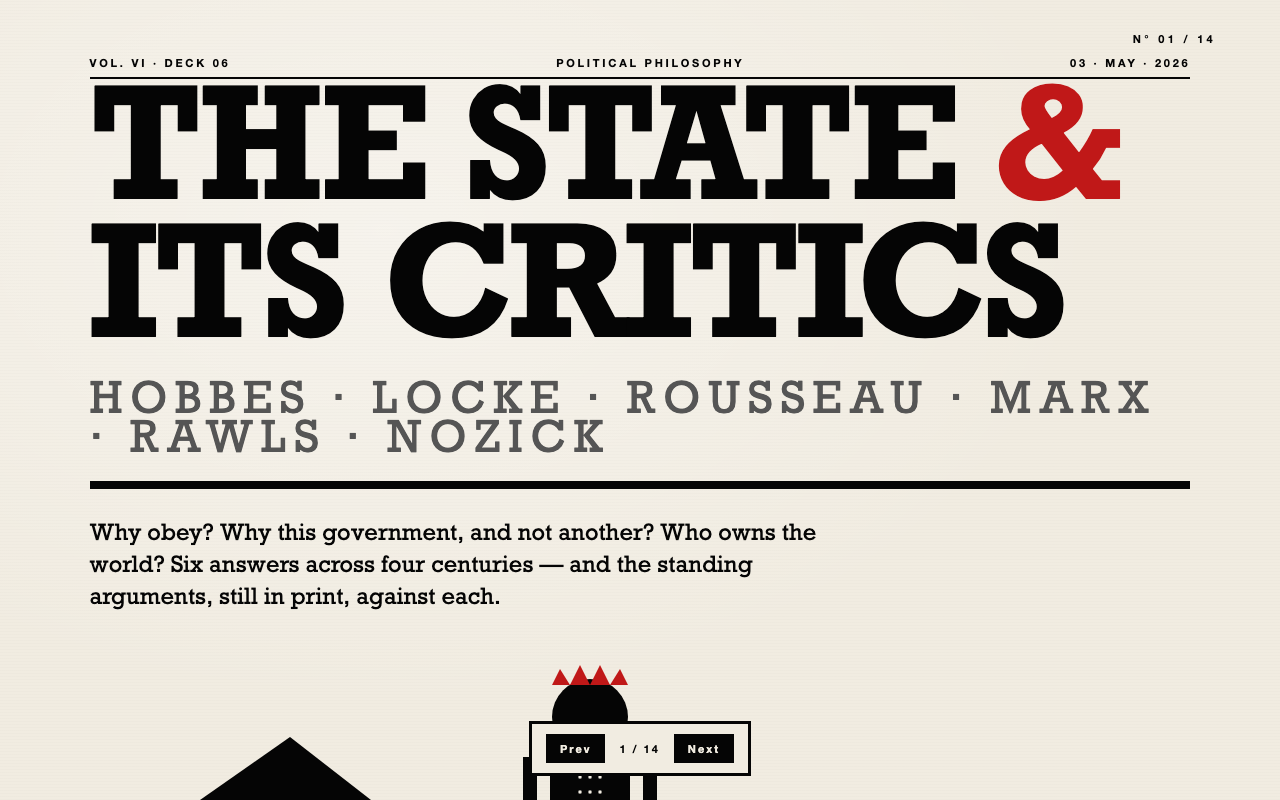
Political Philosophy — Deck 06

Why obey? Why this government, and not another? Who owns the world? Six answers across four centuries — and the standing arguments, still in print, against each.

Philosophy14 slides

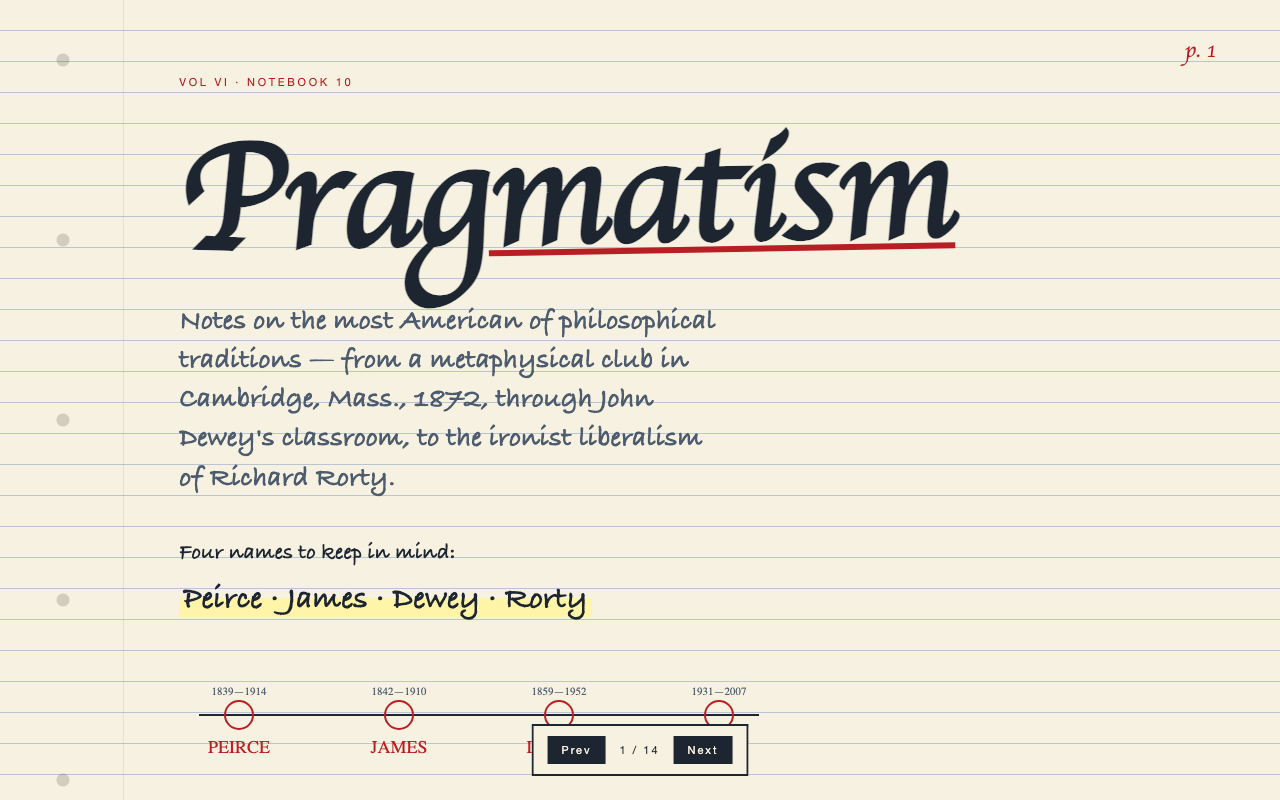
Pragmatism — Deck 10

Notes on the most American of philosophical traditions — from a metaphysical club in Cambridge, Mass., 1872, through John Dewey's classroom, to the ironist liberalism of Richard Rorty.

Philosophy14 slides

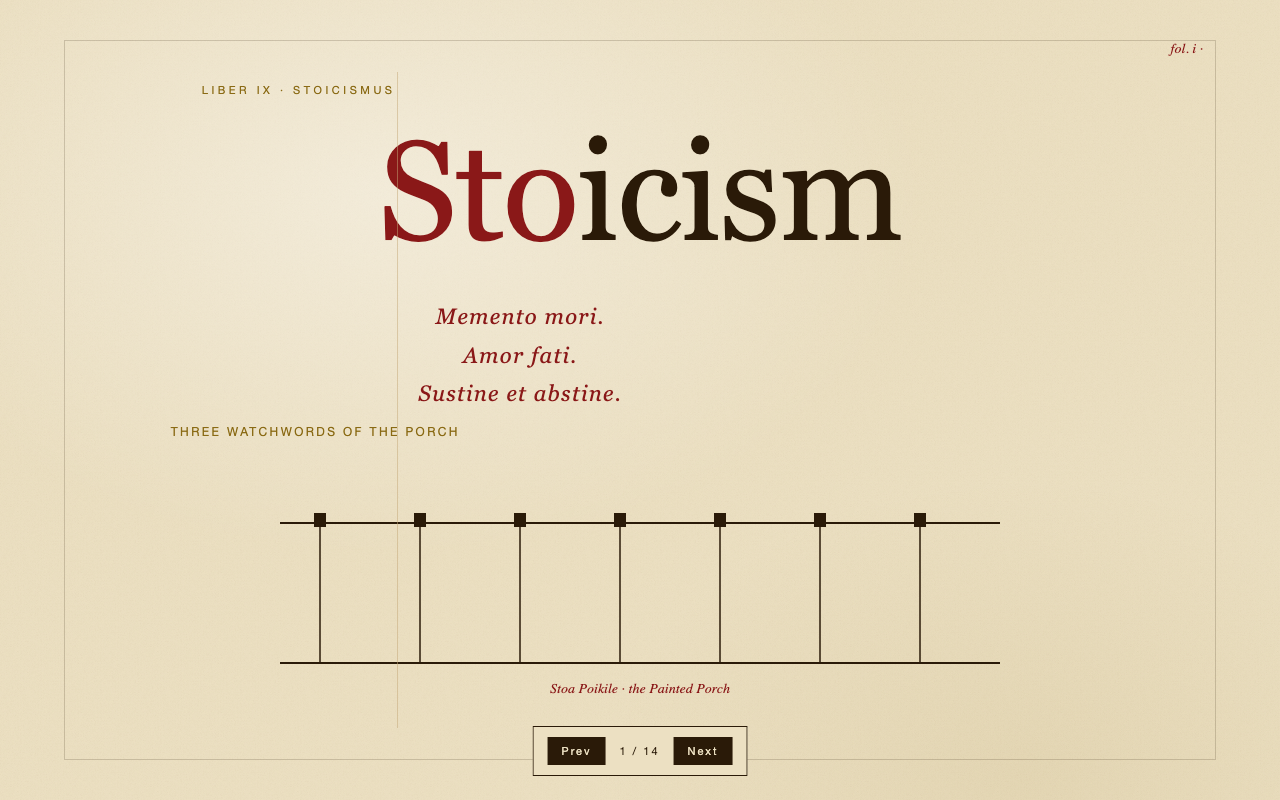
Stoicism — Deck 09

Liber IX · Stoicismus

Philosophy13 slides

Aesthetics — What Makes a Thing Beautiful?

What makes a thing beautiful?

Philosophy13 slides

Greek Philosophy — from Thales to the Stoics

Athens — Aegean — Ionia Greek Philosophy from Thales to the Stoics

Philosophy13 slides

Eastern Philosophy — The Long Traditions

Eastern Philosophy the long traditions

Philosophy14 slides

The Enlightenment — Reason against Tradition

Of the Age of Lights — A Discourse in XIII Plates

Philosophy13 slides

Epistemology — What can be known?

From Plato's Theaetetus to the replication crisis — a brief survey of the theory of knowledge: its objects, its sources, and the limits of what we may justifiably claim to know.

Philosophy13 slides

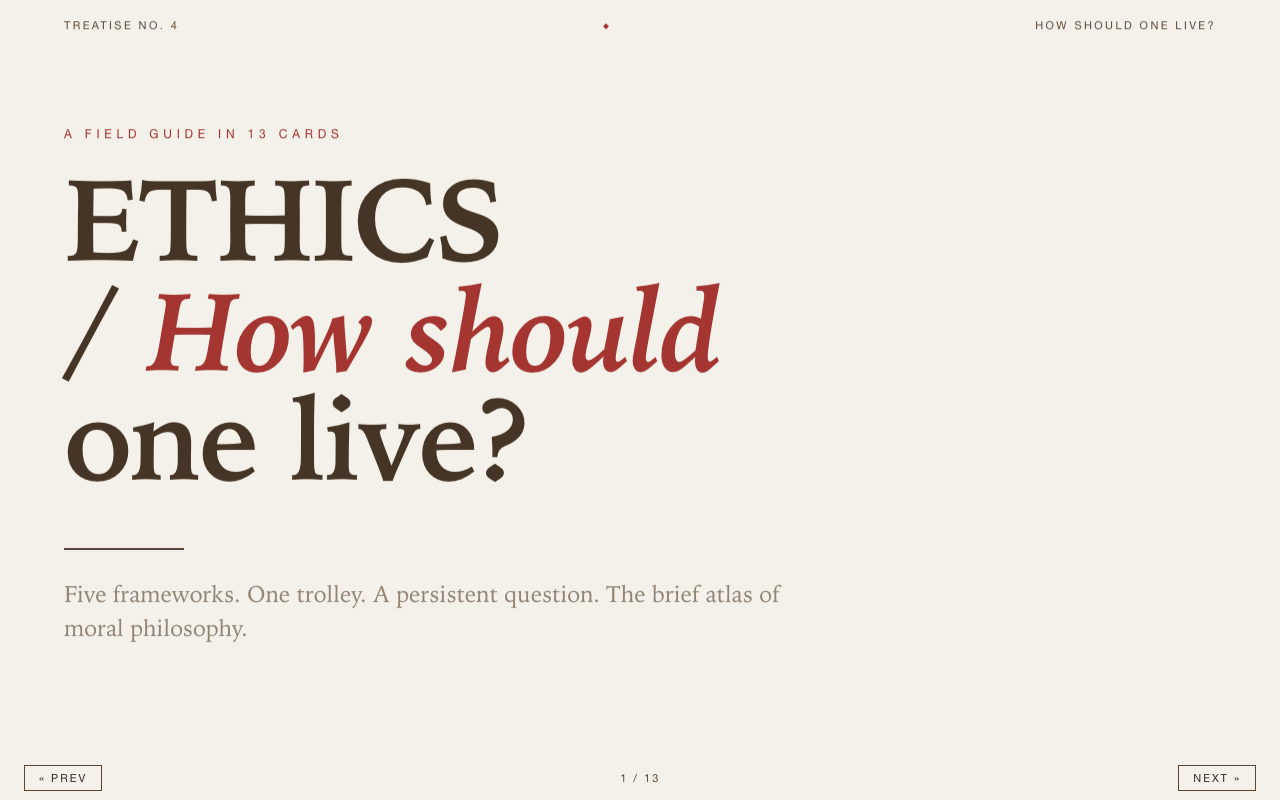
Ethics — How should one live?

Five frameworks. One trolley. A persistent question. The brief atlas of moral philosophy.

Philosophy13 slides

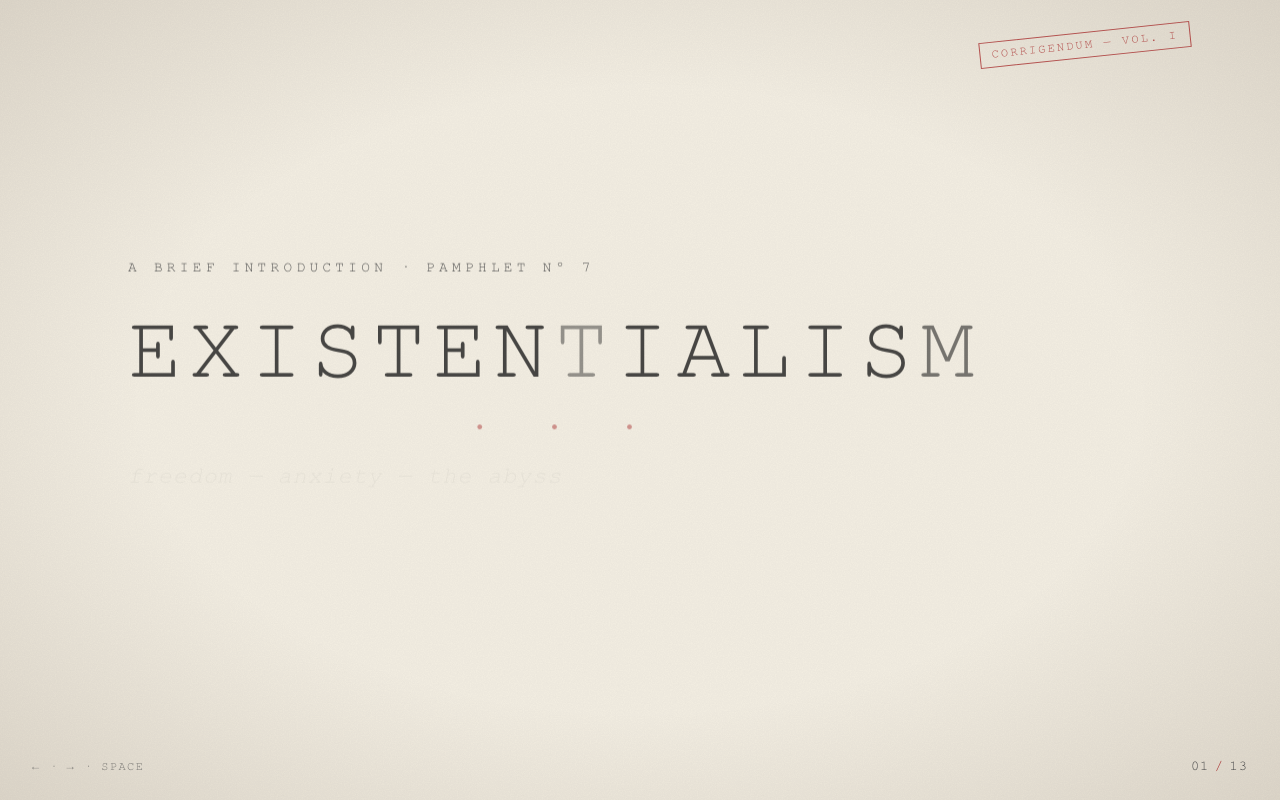
Existentialism — A Brief Introduction

Not “what is the world?”

Philosophy13 slides

Logic — The Form of Valid Inference

From the syllogism to incompleteness: twenty-three centuries of trying to mechanize reasoning, and the discovery that reason itself has limits.

Philosophy13 slides

Philosophy of Mind — The puzzle of the inner life

What is consciousness, why does it feel like anything, and could a machine ever have it? A short tour through the puzzles, positions, and thought experiments that won't sit still.

Philosophy14 slides

Political Philosophy — Justice, Power, the State

Being a brief inquiry into the foundations of authority, the just distribution of goods, and the legitimate use of force among free persons.